News > Pathoplexus July Update
Pathoplexus July Update
By the Pathoplexus Team - 22 July 2026
In our previous update we highlighted many new submissions and the addition of two new organisms to Pathoplexus. In this post, we’ll focus on technical improvements and new features that have been introduced over the past months. Read on to find out more about our latest updates to Pathoplexus:
Sequence and SeqSet citations
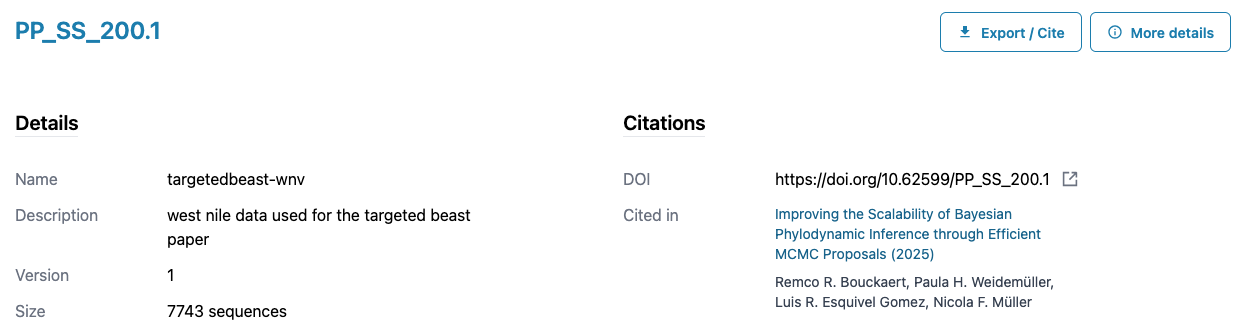
Pathoplexus now integrates data from Crossref to show how SeqSets have been used in scientific publications. You can find this information directly on the SeqSet page. See here for an example of a SeqSet of West-Nile Virus sequences: https://pathoplexus.org/seqsets/PP_SS_200.1.
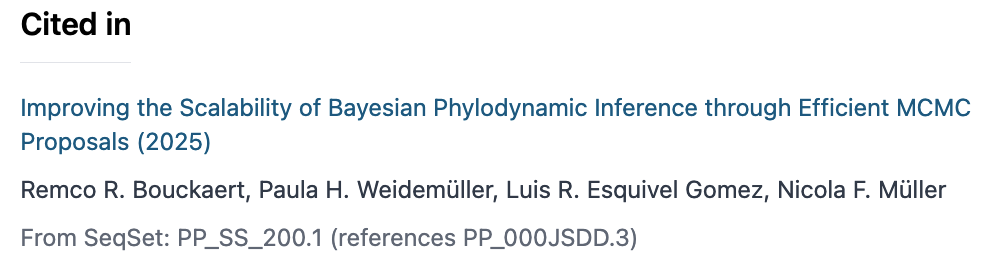
Furthermore, this information is also displayed on the sequence details page when a sequence is part of a SeqSet that has been referenced by a scientific publication, as is the case for this sequence: https://pathoplexus.org/seq/PP_000JSDD.3:
When using a SeqSet in your publications, please remember to generate a DOI and cite it in the references section so those generating and sharing data are properly credited for their work.
Submission workflow
Improved submission template
When submitting your data to Pathoplexus, you can now download a rich XLSX submission template that contains definitions of our metadata fields and - where appropriate - lists accepted values:
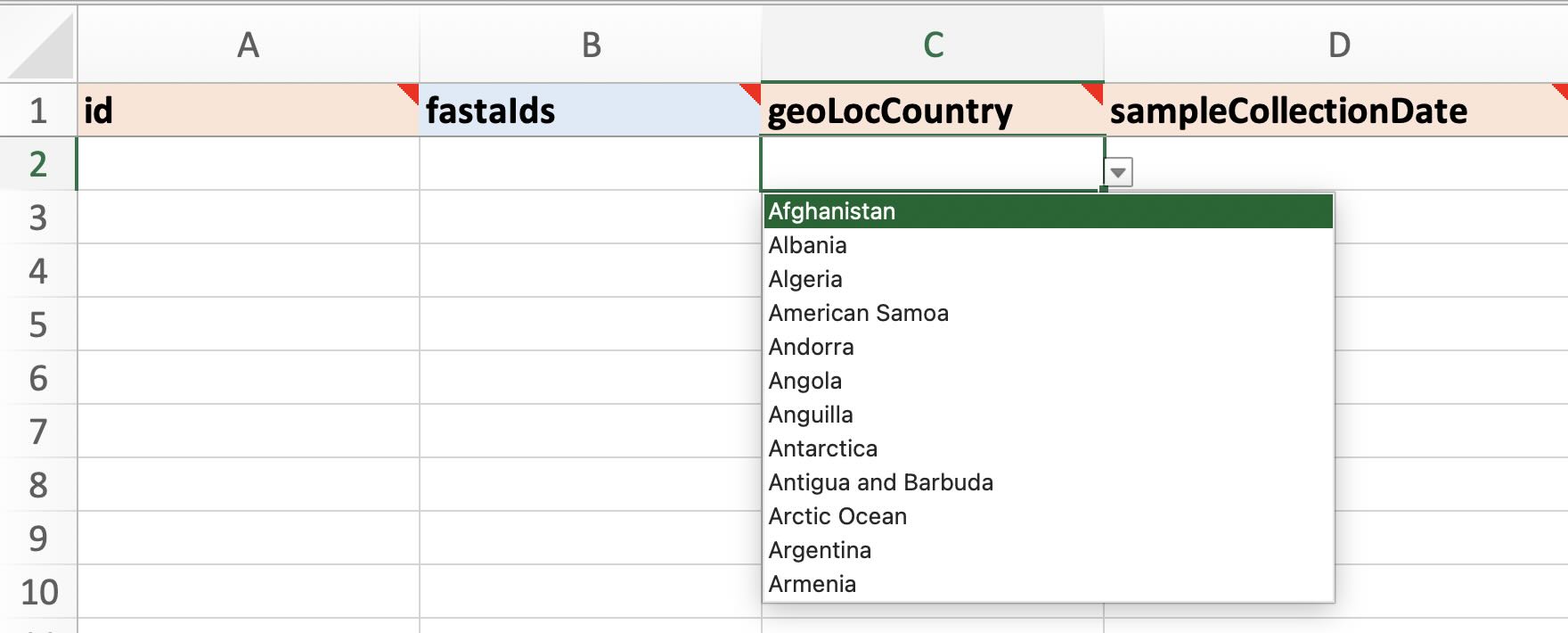
These templates are available on the submission page or in the docs (example for ANDV): https://pathoplexus.org/docs/concepts/metadataformat?organism=andv&fieldType=inputFields.
Improvements to revision and revocation
For sequences submitted by your group(s), it is now also possible to download the original data associated with multiple sequences to simplify batch revisions. Log in and navigate to ‘View’ under ‘Submit Sequences’ for any organism to see previously submitted sequences. Clicking the ‘Download 15 selected entries’ button in the image below would return the original submitted data for all selected sequences:
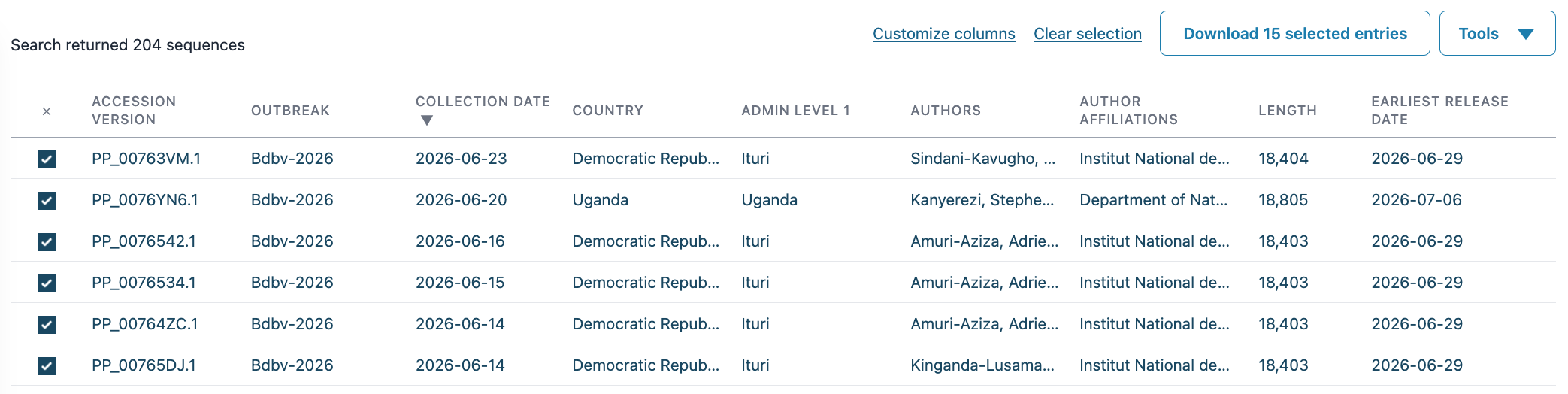
As before, you can also make revisions in the browser for a single sequence (no need to download anything) - but please do remember to use or download the original metadata if you are making bulk revisions!
In a further streamlining of our revocation process, we’ve removed the need to manually release a revocation after you click ‘Revoke this sequence’. Instead, the revocation will immediately be processed after providing a reason for the revocation and clicking ‘Confirm’ in the popup.
Changes to our submission format
We now support date ranges in the Lucene format (e.g., [2014 TO 2015]), as well as the ISO format (e.g., 2026-01-01/2026-02-10). If you are unable to give an exact date, this is a great way to supply useful information nonetheless!
We now validate submitted host details using NCBI taxonomy data. You can specify the host organism by providing a scientific name or NCBI taxon id in the new host metadata field. The submitted data is validated and used to generate the hostTaxonId, hostNameScientific, and hostNameCommon metadata fields. This ensures consistent host designation, and powers our new hierarchical taxonomy search, covered below!
Search improvements
Hierarchical taxonomy search
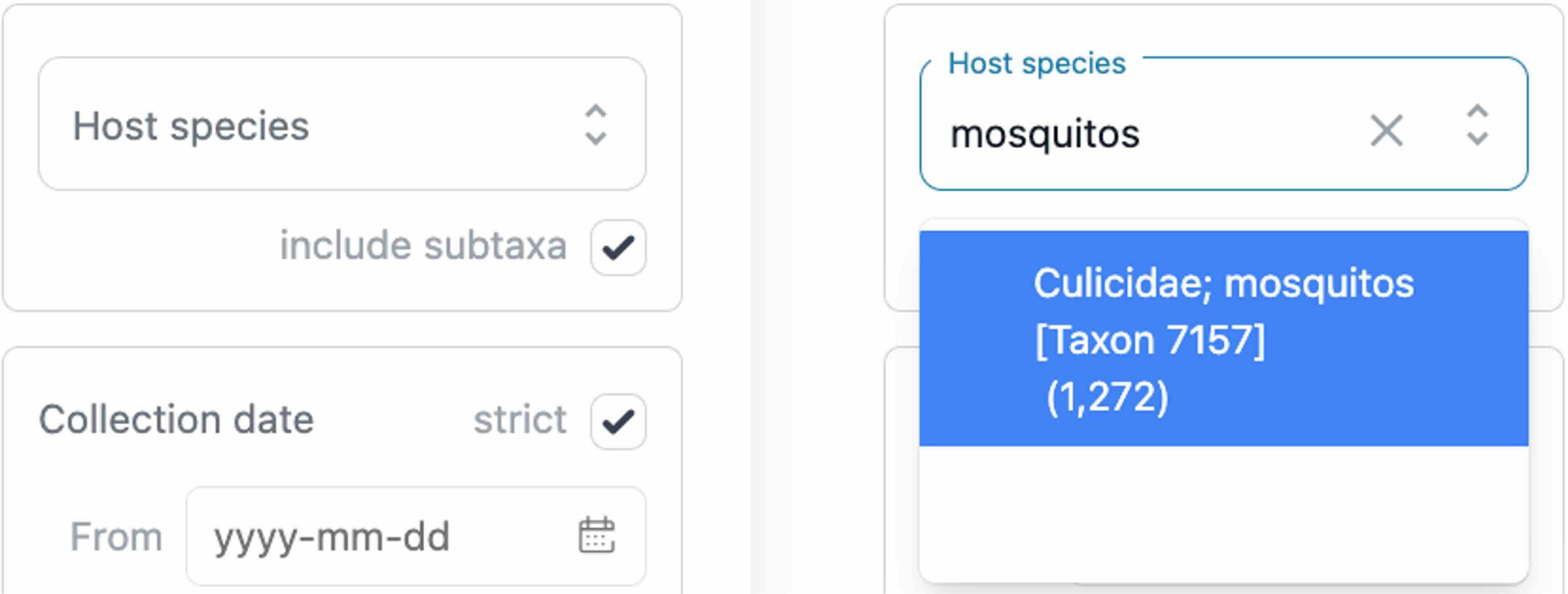
Pathoplexus now validates host metadata, enabling hierarchical taxonomy searches on host information. When a higher-level taxon is selected, the search returns all sequences whose host belongs to any descendant taxon of the selected taxon.
This link, for example, shows all Dengue sequences observed in mosquitos, including seven species in the Aedes genus and two in the Culex genus: https://pathoplexus.org/dengue/search?hostTaxonId=7157*&
New search features
To improve usability, search filters are now organized into collapsible sections for metadata and sequence-based filters. For multi-segmented organisms, sequence filters are further grouped by segment. A new ‘Required segments’ filter also allows users to restrict results to records that include specific genome segments.
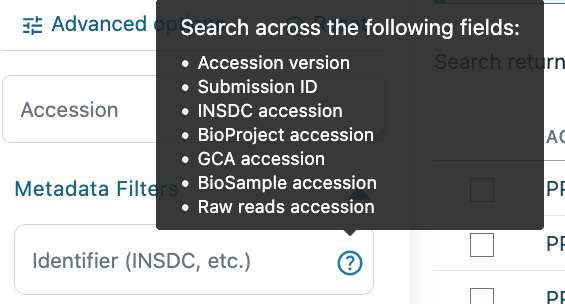
Pathoplexus now supports search across multiple identifiers, e.g. accession, INSDC accession and BioProject accession using a single filter:
Pathoplexus Docs search
The Pathoplexus About and Docs pages now support free-text search for easier access to all types of information about Pathoplexus. This is available through the search box in the top left of these pages, which searches all pages in both sections.
Version comparison
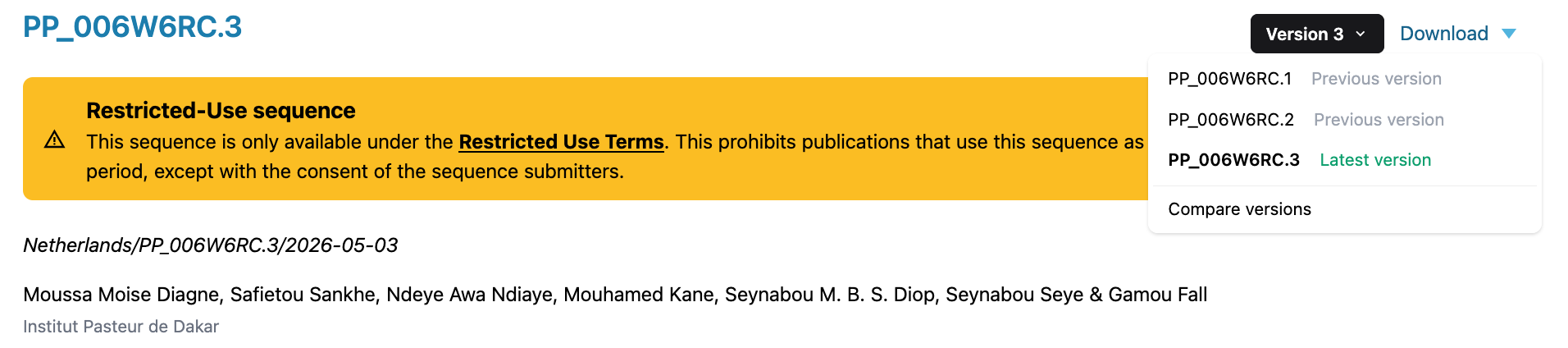
Pathoplexus now has a ‘Compare versions’ feature to show changes between different versions of a sequence. You can find it by clicking the ‘Version’ button on the details page of any sequence with multiple versions:
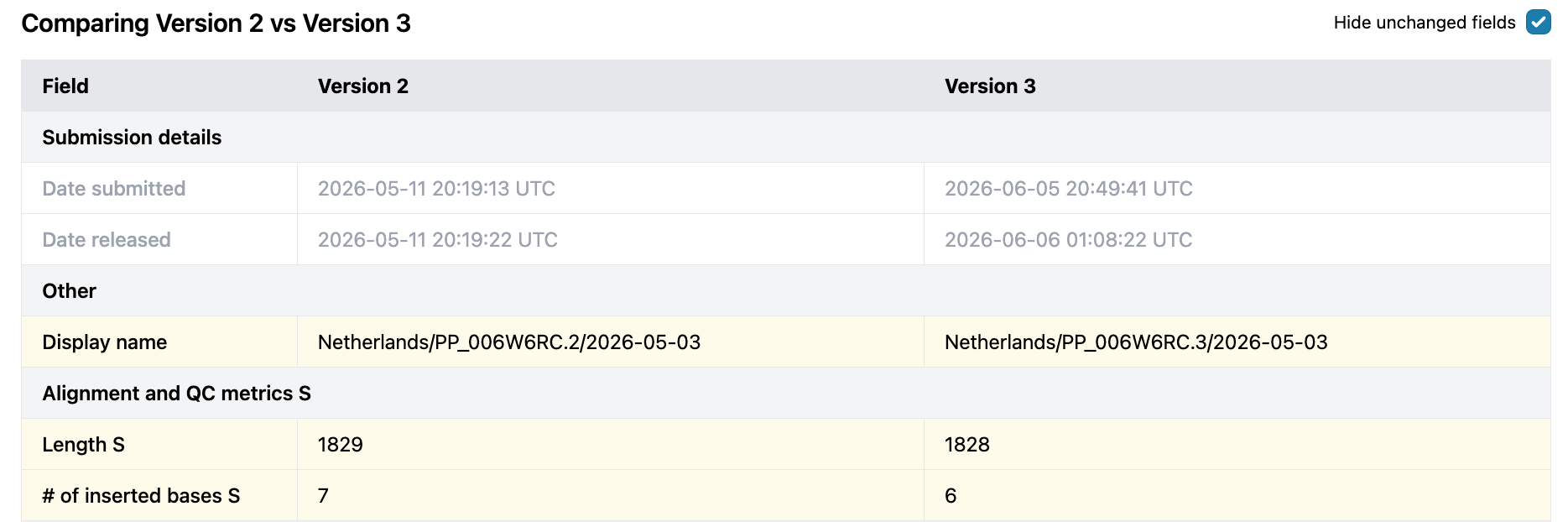
This will take you to a page highlighting which fields have changed between versions in a side-by-side table view. You can specify which two versions of a sequence you would like to compare, as well as whether to hide fields that haven’t changed between versions or not. After configuring the comparison view to your liking, you can share it by simply copying the URL. See here for an example: https://pathoplexus.org/seq/PP_006W6RC.3/versions?compare=2%2C3
Further updates and improvements
Pathoplexus has added support for visualizing amino acid substitutions relative to the Ebola Bundibugyo outbreak clade founder, to allow at-a-glance information about new sequences from the ongoing outbreak.
Pathoplexus now provides Link Outs to view sequence alignments of Pathoplexus sequences using Sealion, or to place sequences on phylogenetic trees constructed using viral UShER and view them using Taxonium.
General assembly and annual report
The members of Pathoplexus met on 10 June 2026 for its General Assembly, reviewing the past year, approving the annual report and discussing the activities of the upcoming year. The minutes of the meeting are available here and the annual report can be found here.
Talks and presentations
Past talks
- 18 March — Emma Hodcroft spoke about Pathoplexus at the 35th Annual Meeting of the Society for Virology in Heidelberg
- 18-20 May - Anna Parker presented a Pathoplexus poster at ViBioM in Vilnius
Upcoming talks
- A poster on data sharing with Pathoplexus will be presented at ECCB in Geneva, 31 Aug to 3 September
Meetings, minutes, and resolutions
Pathoplexus is very pleased to announce that Prof. Placide Mbala has joined the Pathoplexus Scientific Advisory Board.
Remember that you can always check our minutes from General Assemblies and Executive Board meetings, as well as Executive Board resolutions.